
Episode Summary
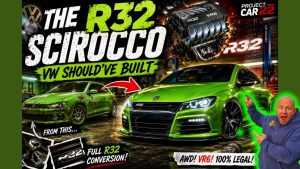
In Part 1 of this ambitious Volkswagen project, Project Car 22 begins transforming a Scirocco with a blown 1.4 TSI engine into the R32-powered, all-wheel-drive machine Volkswagen never built. After stripping the Golf R32 donor car, modifying the Scirocco’s boot floor and installing the complete R32 rear running gear, the build reaches its first major milestone with an OEM-style finish. With the rear conversion complete, the next instalment turns to the front-end, engine swap and wiring as the ultimate R32 Scirocco starts to take shape.
Transforming a Mk3 Scirocco into the R32 Volkswagen Never Built
Sometimes a project comes along that feels too good not to build. After picking up a clean Volkswagen Scirocco with a failed 1.4 TSI engine, Project Car 22 decided against a straightforward engine replacement. Instead, the plan became far more ambitious—transforming the car into what many enthusiasts believe Volkswagen should have produced from the factory: an R32-powered Scirocco.
This build combines the complete running gear from a Volkswagen Golf R32 donor car with the sleek body of the Mk3 Scirocco. In Part 1, the focus is on dismantling both vehicles, preparing the chassis, and completing one of the biggest fabrication jobs of the entire conversion.
Why Build an R32 Scirocco?
The original Scirocco is a fantastic-looking coupe, but many examples were fitted with the 1.4 TSI engine—a unit that has developed a reputation for reliability issues.
Rather than replacing the failed engine with another standard unit, the decision was made to use an entire Golf R32 donor car. The goal is to transplant the R32 drivetrain, suspension, differential and supporting components into the Scirocco, creating a factory-style conversion that Volkswagen never officially produced.
Stripping the Golf R32 Donor
The project begins by removing everything required from the Golf R32.
The rear of the donor is dismantled first, including:
- Rear subframe
- Rear differential
- Rear suspension
- Brake assemblies
- Exhaust system
- ABS wiring
- Brake lines
Although some of the fasteners proved stubborn, the complete rear assembly was removed without major complications.
Once removed, it became obvious that several components would benefit from refurbishment before installation. The rear shock absorbers had reached the end of their service life, while the brake discs and pads were heavily worn, making replacement the logical choice before the swap.
After removal, the complete assembly was thoroughly pressure washed to prepare it for installation into the Scirocco.
Preparing the Donor Shell
Attention then turned to stripping the remainder of the Golf R32.
Work included:
- Removing the interior
- Cutting out the boot floor section
- Removing the fuel tank
- Disconnecting the prop shaft
- Removing brake lines and ABS wiring
- Extracting sections of the wiring loom
- Preparing the battery tray area
One surprising discovery during dismantling was how little factory underbody protection these Volkswagen models received, especially considering the UK’s wet climate.
The fuel tank was cleaned and prepared for reuse before moving on to the fabrication work.
Preparing the Scirocco for AWD Conversion
With the donor stripped, work began on the Scirocco.
The standard rear axle assembly was removed using essentially the same procedure as the Golf:
- Disconnect ABS sensors
- Disconnect brake lines
- Remove handbrake cables
- Undo rear subframe bolts
- Lower the complete rear assembly
With both rear assemblies sitting side by side, the similarities between the two platforms became clear. Although there are significant differences, many of the mounting locations align remarkably well, making the conversion more achievable than first expected.
Modifying the Boot Floor
One of the largest fabrication jobs in the build involves replacing the Scirocco boot floor with the corresponding section from the Golf R32.
This modification creates the space required for:
- Rear differential
- AWD rear suspension
- Prop shaft clearance
- Correct factory-style mounting points
The original floor was carefully trimmed while avoiding unnecessary removal of structural chassis sections. The aim throughout the project is to make the finished conversion appear as close to an OEM installation as possible.
Spot Welding vs Seam Welding: Why Factory Methods Matter
A common misconception online is that manufacturers seam weld every panel.
In reality, Volkswagen and many other manufacturers—including Audi, Ford and Vauxhall—primarily use spot welds combined with structural panel adhesive during production.
Spot welding offers several advantages:
- Reduces heat distortion
- Prevents panel warping
- Replicates factory construction methods
- Maintains structural integrity
To replicate OEM standards, the new boot floor was installed using:
- Structural adhesive (Tiger Seal)
- Spot welds
- Seam sealer around all joins
This approach closely mirrors modern factory body repair procedures.
Upgrading the Underbody Protection
Once the fabrication was complete, attention turned to protecting the underside of the vehicle.
Unlike the original factory finish, additional protection was applied throughout the wheel arches and underbody using colour-matched Cobra Bedliner.
The result provides:
- Improved corrosion protection
- Greater stone-chip resistance
- Factory-style appearance
- Long-term durability
The colour-matched finish gives the underside of the car a far more premium appearance than the original factory coating.
Installing the Golf R32 Rear Running Gear
With the floor complete, the refurbished Golf R32 rear assembly was lifted into place.
Working on the floor rather than a vehicle lift made the installation considerably more challenging, requiring:
- Multiple trolley jacks
- Axle stands
- Careful alignment of the complete rear assembly
Despite the awkward working conditions, the rear axle, suspension and differential were successfully installed into the Scirocco.
The project had officially reached its first major milestone.
Phase One Complete
By the end of Part 1, the transformation is already well underway.
Completed work includes:
- Golf R32 rear subframe installed
- Rear differential fitted
- New rear suspension installed
- Boot floor conversion completed
- Underbody protection applied
- Rear running gear successfully mounted
With the rear of the vehicle now converted, the next phase will focus on:
- Front subframe installation
- Engine conversion
- Wiring integration
- Interior installation
- Final drivetrain assembly
Unlike previous fully custom builds, much of the Golf R32 hardware is expected to transfer directly into the Scirocco, making this conversion considerably more straightforward while still delivering an incredibly unique result.
Tools Used
- Trolley jack(s)
- Axle stands
- Wheel brace/socket set
- WD-40 penetrating lubricant
- Pressure washer (jet washer)
- Spot welder
- Angle grinder/cutting tools
- Welding equipment
- Seam sealer
- Tiger Seal structural adhesive
- Cobra Bedliner coating equipment
- Battery charger
Parts & Specifications Mentioned
Donor Vehicle
Volkswagen Golf R32
Recipient Vehicle
Volkswagen Scirocco (Mk3)
Original Engine
1.4 TSI turbocharged petrol engine
Components Removed
Rear subframe
Rear differential
Rear suspension
Exhaust system
Fuel tank
Prop shaft
ABS wiring
Brake lines
Wiring loom
Battery tray
Boot floor panel
Components Installed
Golf R32 rear subframe
Golf R32 rear differential
Golf R32 boot floor
New rear suspension
New rear brake discs
New rear brake pads
Colour-matched Cobra Bedliner underbody coating
Tiger Seal structural adhesive
Seam sealer
Technical Specifications Mentioned
No engine codes, torque settings or manufacturer torque specifications were stated during this episode. The focus is primarily on chassis preparation, fabrication and rear drivetrain installation.
Episode Summary
Part 1 lays the foundation for one of Project Car 22’s most ambitious builds by converting a failed 1.4 TSI Scirocco into an R32-powered, all-wheel-drive machine. After stripping both vehicles, modifying the boot floor and installing the Golf R32 rear running gear, the project reaches its first major milestone with an OEM-style finish. With the rear conversion complete, the next episode moves on to the front-end, engine installation and wiring that will finally bring Volkswagen’s “missing” R32 Scirocco to life.